Every year, trustees of thousands of small and medium-sized charities face the same question: what do we need to do in terms of creating accounts and independent examination?
Whilst an independent examination is less detailed than a full audit, it is still a legal requirement for most charities. Choosing the wrong person to carry out your independent examination can result in extra work for you and additional costs for your charity.
Whilst it’s the charity’s responsibility to ensure they understand fund accounting and create accounts that are accurate, an independent examination is an important part of the account creation process. It should highlight key issues or things that may have been missed.
A thorough independent examination will also look beyond the numbers in the accounts and include other important areas such as the financial processes the charity has. A good independent examiner will also support the charity with more complex fund accounting questions that may come up during the year, such as how to correctly account for a multi-year grant. Therefore, choosing the right independent examiner is important.
Many charities assume that because their independent examiner is a qualified accountant, the person examining their accounts will know what they are doing. Unfortunately, most qualified accountants work in business accounting rather than charity accounting, the rules for which are quite different. This can result in fundamental errors, such as grants and restricted donations that are not being accounted for correctly, not being spotted by the independent examiner.
This guide explains what an independent examination is, who can carry one out, what it costs and how the process works. It includes top tips, questions to ask, and factors to consider.
Table of contents
- Understanding independent examination
- What is an independent examination of charity accounts?
- How is independent examination different from an audit?
- Does my charity need an independent examination?
- Are small charities exempt from requiring an independent examination?
- Do all types of charity need an independent examination?
- Are the rules for independent examination the same in Scotland and Northern Ireland?
- What does an independent examiner actually check?
- What is the independent examiner’s Report?
- What happens if the independent examiner finds a problem?
- What are the deadlines for filing accounts?
- What if a charity does not get its accounts examined, or files late?
- Choosing an independent examiner
- Who can be an independent examiner?
- Does an independent examiner need to be a qualified accountant?
- What qualifications and experience should an independent examiner have?
- What does ‘independent’ mean, in terms of choosing an independent examiner?
- Can the person who prepared the accounts also independently examine them?
- Can a volunteer independently examine charity accounts?
- How do I find an independent examiner?
- How do I check that an independent examiner is reputable and competent?
- What questions should I ask a prospective independent examiner?
- How do I appoint an independent examiner?
- Can the same independent examiner be used year after year?
- Costs
- The process
- How long does an independent examination take?
- What documents and records will my independent examiner need?
- What do I need to do ahead of an independent examination?
- What are the most common issues independent examiners find?
- Can the examiner fix errors without compromising independence?
- What happens once the independent examination is complete: who signs and who files?
- What is the independent examiner’s responsibility versus the trustees’?
- Can the independent examiner refuse to sign off the charity accounts?
- Final thoughts
Estimated reading time: 19 minutes
Understanding independent examination
What is an independent examination of charity accounts?
An independent examination is a review of a charity’s accounts and records by someone who is independent of the charity and has the right skills and experience.
The examiner checks:
- that the accounts broadly agree with the charity’s records;
- that the accounts have been prepared in line with the relevant accounting rules (for example, the Charities SORP);
- and that nothing has come to light that needs reporting to the regulator.
They then provide a short written report that is attached to the accounts.
How is independent examination different from an audit?
An audit is a much more detailed process than an independent examination. Auditors test the figures in depth, gather evidence, assess internal controls and give a formal opinion on whether the accounts give a true and fair view.
In an independent examination, the examiner carries out specific checks and reports on whether anything has caught their attention, but does not provide the same level of assurance as an audit. This is why, although an independent examination is quicker and cheaper, it is only available to charities below certain size limits.
However, not all independent examinations are equal. Some are very light touch, and some even miss basic errors, whilst others are much more detailed, providing a far greater level of assurance.
In our experience, independent examiners who specialise in the examination of charity accounts and have in-depth fund accounting knowledge and a detailed understanding of the Charities SORP, such as Stewardship or Wyatt & Co, often provide a far more comprehensive independent examination, spotting error and raising questions that other independent examiners miss or don’t cover.
Does my charity need an independent examination?
If your charity needs an independent examination depends on your size, your legal structure and your governing document. If your charity is below the income threshold for an audit but above the income level at which an external check is required, as a general rule, you will need an independent examination.
Thresholds differ by country and change from time to time, so check the current figures. For financial years ending on or after 30 September 2026 in England and Wales, an audit is generally required if gross income is above £1.5 million, or if gross income is above £500,000 and gross assets are above £5 million.
Charities below those levels can usually choose an independent examination, unless their governing document says otherwise. Charities with income below £40,000 may not need an external check at all.
Find out more about charity accounting thresholds here.
Are small charities exempt from requiring an independent examination?
Very small charities are often exempt from the legal requirement for an external check, but exemption in law does not always mean exemption in practice.
Charities with income under £40,000 generally do not need an external examination, although some governing documents still require one.
Your constitution or trust deed may still require an examination, and funders or banks may ask for examined accounts. Many trustees choose to have an examination anyway because it builds confidence and catches errors early.
Do all types of charity need an independent examination?
The rules apply across different legal structures, but the details vary:
- Unincorporated associations and trusts follow the Charities Act rules and their governing document.
- Charitable incorporated organisations (CIOs) follow the Charities Act rules, which set the same audit and examination thresholds as other charities.
- Charitable companies limited by guarantee must also comply with company law, including filing accounts at Companies House, so they have additional obligations.
If your charity is a company, make sure the examiner understands both charity and company requirements.
Are the rules for independent examination the same in Scotland and Northern Ireland?
No. Scotland is regulated by OSCR and Northern Ireland by the Charity Commission for Northern Ireland, and each has its own thresholds, report formats and deadlines. For example, the point at which an audit becomes mandatory is not the same as in England and Wales. If you operate in more than one nation, check each regulator’s rules and make sure your examiner is familiar with them.
What does an independent examiner actually check?
The examiner’s work is focused on a defined set of checks. In broad terms, they will look at whether:
- accounting records have been kept and the accounts agree with them;
- the accounts follow the correct accounting basis (for example, receipts and payments or accruals);
- the charity’s records and accounts are consistent with each other and with the examiner’s own understanding of the charity;
- there are any matters that should be brought to the attention of the regulator, such as signs of fraud, misuse of funds or breaches of charity law.
They will usually ask questions, review bank statements, sample transactions and check key balances, but they do not test everything in the way an auditor would.
Traditionally, this would require putting together and sending over all of the reports, receipts and other documents requested by the independent examiner, which is extremely time-consuming. Modern cloud-based fund accounting software like ExpensePlus removes the need to do this, and instead provides independent examiners with read-only access to most of the information they need.
What is the independent examiner’s Report?
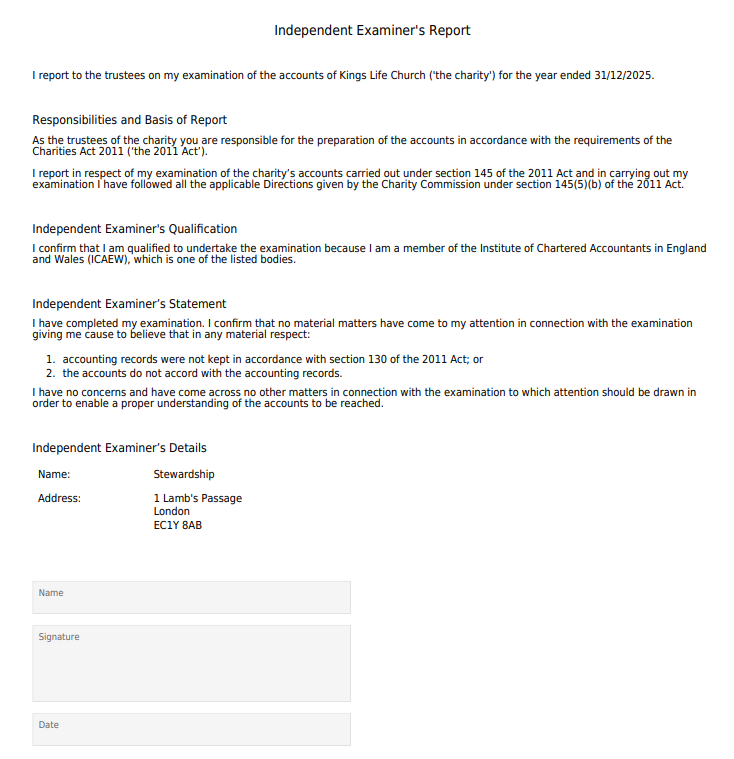
The report is a short, standardised statement signed by the examiner and attached to the accounts. It sets out who carried out the examination, what the examiner did, and whether anything came to their attention that needs reporting.
Most reports are one or two pages. The report format is prescribed by the regulator, so examiners should use the correct version for your jurisdiction.
What happens if the independent examiner finds a problem?
Minor errors are usually corrected before the report is signed. If the examiner finds something more serious, such as missing records, unexplained transactions or a possible breach of trust, they will raise it with the trustees first.
If the issue is not resolved, or if it is a matter of material significance to the regulator, the examiner may have to qualify their report or report the matter directly. This is a normal part of the role, not a sign that the examiner is being difficult.
What are the deadlines for filing accounts?
In England and Wales, charities registered with the Charity Commission must generally submit their annual return and accounts within ten months of the financial year end.
Charitable companies must file accounts at Companies House earlier, normally within nine months.
The Scottish Charity Regulator OSCR and the Charity Commission for Northern Ireland have their own deadlines.
It’s best not to leave independent examination until the last minute. And keep in mind that your independent examiner is likely to have other clients, so your independent examination may not happen straight away.
It’s worth letting your independent examiner know when you plan to sign off your accounts, and asking them upfront when they need your draft accounts. This makes sure that time is built in for the examination, any questions the examiner raises, and trustee approval afterwards.
What if a charity does not get its accounts examined, or files late?
Late or missing accounts can result in the charity being flagged as non-compliant on the public register, which can affect funding and reputation.
Regulators can also open a compliance case, and repeated failures may lead to formal action against trustees.
Companies House can impose automatic late filing penalties on charitable companies. If you are running late, contact the regulator early and explain what you are doing to catch up.
To avoid the risk of filing accounts late, it’s best to start the process of creating accounts within one to two months of the end of each financial year.
If you are using a charity accounting package like ExpensePlus, then built-in tools can help ensure that nothing gets missed when creating year end accounts. For example, ExpensePlus includes:
- a year end accounts template, making the creation of accounts quick and easy
- free training and a checklist for creating accruals accounts and for receipts and payments accounts.
Choosing an independent examiner
Who can be an independent examiner?
The law says an independent examiner must be someone who is independent of the charity and who has the requisite ability and practical experience to carry out a proper examination.
There is no single qualification that applies to every charity, but the level of expertise required rises with the size and complexity of the charity.
Using an independent examiner who specialises in the examination of charity accounts and has an in-depth understanding of the Charities SORP is really advantageous and highly recommended.
Does an independent examiner need to be a qualified accountant?
Not always. For smaller charities, an examiner does not have to be a qualified accountant, provided they have appropriate skills and experience.
However, once a charity’s income is more than £250,000 in England and Wales, the examiner must be a member of a listed professional body, such as ICAEW, ICAS, ACCA, CIPFA or similar.
While having an accountant as your independent examiner can provide reassurance, an important factor to consider is whether they are a business accountant or a charity accounting specialist. The two are quite different, and using an independent examiner who has in-depth knowledge of charity accounting is key to providing true reassurance that the charity accounts are SORP-compliant.
What qualifications and experience should an independent examiner have?
Look for someone who:
- has experience of charity accounts, ideally of a similar size and type to yours;
- understands the relevant accounting framework, including the Charities SORP where it applies;
- is familiar with your regulator’s examination requirements and report format;
- can communicate clearly with trustees who may not have a financial background;
- is recommended by other charities.
An independent examiner with little or no experience of charity accounting is unlikely to be suitable.
What does ‘independent’ mean, in terms of choosing an independent examiner?
Independence means the examiner has no close connection with the charity that could compromise their objectivity. In practice, an examiner should not be:
- a trustee of the charity, or someone who has been a trustee recently;
- an employee or someone who is paid to carry out work for the charity beyond the examination (such as keeping the books);
- a close family member, business partner or someone otherwise closely connected to a trustee or senior employee.
The test is whether a reasonable outsider would think the examiner could be influenced by their relationship with the charity.
Can the person who prepared the accounts also independently examine them?
Someone cannot examine their own work. If your bookkeeper or accountant prepares the accounts, you will need a different person to carry out the examination.
It’s common for some independent examiners to offer to prepare accounts in addition to examining them for an additional fee. This is made possible by the independent examiner using different individuals in their team, one to create the accounts and the other to independently examine them.
Can a volunteer independently examine charity accounts?
Yes, a volunteer can act as an examiner if they are genuinely independent and have the necessary skills.
A member of the charity is not automatically excluded, but they must not be closely involved in running it or in preparing the accounts. However, take care that being a long-standing supporter does not create a perception of bias.
In practice, using a volunteer independent examiner can come with challenges, particularly if they don’t have the necessary knowledge of fund accounting or the requirements of what is needed for an independent examination. If your charity uses an independent examiner who asks very few questions when you send them your draft accounts, this may provide a bit of a warning that the independent examination isn’t as thorough as it should be.
How do I find an independent examiner?
Most commonly, asking other charities you are in contact with for their recommendation is the best option, as they will be able to share their experience, answer questions, and let you know whether they would recommend them.
Alternatively, you may wish to ask funders or umbrella bodies that you are in contact with if they can suggest examiners.
It is always worth approaching more than one independent examiner so you can compare approach, experience and fees.
Independent examiners do not need to be located nearby, and typically all interactions with your independent examiner will be via email, phone or video call.
Whilst the cost of the independent examination is important, typically, this should not be the main determining factor. Many charities make the mistake of either going for the cheapest option to save money, or a more expensive option in the hope that the independent examination will be more thorough. Rarely is this a good approach, and often charities end up paying a low fee for a substandard independent examination, or paying more for an independent examination that is no better.
If you are not sure where to start, we’d recommend including Stewardship or Wyatt & Co on your shortlist of independent examiners to contact. Both specialise in providing independent examination services to charities.
Note: We do not get any benefit from recommending the providers; we do so because they are highly rated by the many charities that use them.
How do I check that an independent examiner is reputable and competent?
- Ask for their qualifications and professional memberships, and verify these with the relevant body.
- Check that they have experience in fund accounting and the Charities SORP.
- Ask for references from other charities they have examined.
- Check whether they hold professional indemnity insurance.
- Ask for an example of how they would explain their findings to trustees.
What questions should I ask a prospective independent examiner?
- How many charities do you examine, and are any similar to ours?
- Are you a member of a professional body?
- Do you have professional indemnity insurance?
- What is your fee, and what does it include?
- How long will the examination take, and what timetable do you propose?
- What do you need from us, and in what format?
- If we provide you with access to our fund accounting package (e.g. ExpensePlus), are you willing to get the reports and receipts etc. that you need directly, which will save us a lot of time?
- How do you handle queries and any problems you find?
- Is there any reason you would not be considered independent?
How do I appoint an independent examiner?
Trustees should agree the appointment at a trustee meeting and record it in the minutes, noting that they have considered the examiner’s independence and suitability.
It is good practice to sign a letter of engagement with the examiner that sets out the scope of work, the fee, timing, the responsibilities of each party and the independence confirmation.
This protects both sides if there is a later disagreement.
Can the same independent examiner be used year after year?
Yes, there is no legal limit. Continuity can make the process smoother because the examiner already understands your charity.
However, it is good practice to review the appointment regularly, consider whether independence is still intact, and occasionally test the market for fees and quality.
Some charities rotate examiners every few years as a matter of policy.
Costs
How much does an independent examination cost?
There is no standard fee. Costs vary widely depending on the size of the charity, the quality of its records and who carries out the work.
Small charities with simple finances and well-organised records may expect to pay a few hundred pounds, while a larger or more complex charity could pay a few thousand.
Treat any figures you see online as a rough guide and obtain quotes, but remember, whilst cost is important, this should not necessarily be the main determining factor.
Many charities make the mistake of either going for the cheapest option to save money, or a more expensive option in the hope that the independent examination will be more thorough.
Rarely is this a good approach, and often charities end up paying a low fee for a substandard independent examination, or paying far too much for an independent examination that is no better.
One of the best ways to keep costs down is to have tidy records ready at the start of the examination.
Is the independent examination fee based on income, complexity or time?
The independent examiner fee is based mostly on time and complexity. Income can be a rough proxy, but a charity with a simple income stream may be cheaper to examine than a smaller one with multiple restricted funds, grants, property or trading activity.
Poor record keeping and late responses to queries from the charity almost always increase the fee. Using a fund accounting package like ExpensePlus that enables charities to create accurate accounts easily and make independent examination far easier will reduce the fee.
Using a checklist at year end to ensure that the draft accounts are correct before these are sent to the independent examiner will help to limit the extra work needed by the independent examiner and remove the need for fee increases relating to additional time being required.
Is an independent examination cheaper than an audit?
Typically, yes, an independent examination is cheaper than an audit. An independent examination involves less testing and less formal evidence gathering than an audit, so the fee is usually substantially lower. The difference can be significant, often a fraction of the audit cost, but the exact saving depends on your charity’s size and complexity.
Do volunteer independent examiners exist, and is it appropriate to use one?
Yes, and some charities find a volunteer examiner through their local charity and voluntary sector network or a professional body’s volunteering scheme. It can be a good option for very small charities, provided the volunteer is independent, has the right knowledge and skills, and is willing to follow the regulator’s requirements.
An excellent knowledge of both fund accounting and what the independent examination should involve is key to using an independent examiner that isn’t being paid.
The process
How long does an independent examination take?
For a small charity with good records, the main work involved in carrying out an independent examination is typically completed in a few hours to a couple of days, with the overall process spread over several weeks to allow for questions and trustee approval. Larger or more complex charities will take longer.
It’s best to agree a timetable up front and book your examiner early, particularly if your year end falls at a busy time such as 31st March or 31st December.
What documents and records will my independent examiner need?
Expect to provide:
- the draft accounts and trustees’ annual report;
- bank statements;
- trustee minutes and your governing document;
- records of assets, liabilities and any loans or commitments.
Using cloud-based fund accounting software like ExpensePlus will save time and avoid the need for you to send your independent examiner:
- accounting reports and records
- invoices, receipts and supporting evidence for income and expenditure
- details of grants, restricted funds and any gifts in kind
What do I need to do ahead of an independent examination?
- Reconcile bank accounts and check balances at the year end.
- Make sure all income and expenditure is recorded and supported.
- Separate restricted and unrestricted funds clearly.
- Complete the draft accounts and trustees’ report before the examination begins.
- Gather the supporting documents in an organised file or folder.
- Nominate one person to answer the examiner’s questions promptly.
If your charity uses ExpensePlus, with inbuilt fund management and automated bank reconciliation, then record keeping and the process of creating accounts is simple. Whilst you will still need to provide some supporting documents, the work involved to create year end accounts and have accounts independently examined is much simpler and quicker.
What are the most common issues independent examiners find?
- Bank reconciliations that do not balance, or are missing altogether.
- Missing or incomplete supporting documents.
- Restricted funds that are not tracked or reported properly.
- Accounts prepared on the wrong basis for the charity’s size.
- Missing disclosures, such as trustee expenses or related party transactions.
- Weak financial controls, such as one person handling all cash.
Can the examiner fix errors without compromising independence?
An examiner can point out errors and explain what needs to be corrected, and this is a normal part of the process.
What they cannot do is prepare or substantially write the accounts themselves and then examine them.
If you need help preparing the accounts, it’s worth asking whether your independent examiner is able to provide this as an additional service, or whether you might be better off switching to a better accounting package that will help avoid errors and make the process of creating year end accounts much simpler.
What happens once the independent examination is complete: who signs and who files?
Once the examiner is satisfied, they sign their report. The trustees then approve and sign the accounts.
The trustees are responsible for filing the accounts with the Charity Commission and, for charitable companies, with Companies House as well.
Some independent examiners may offer to do this on the charity’s behalf, but this is worth checking.
The charity should keep a copy of the signed accounts (including the trustees’ annual report) for their records, and make them available to anyone who requests these.
Financial records should also be kept for at least 6 years.
What is the independent examiner’s responsibility versus the trustees’?
Trustees are responsible for keeping proper accounting records, preparing accurate accounts, putting good controls in place and filing on time.
The examiner’s responsibility is narrower: to carry out the checks required, report honestly on what they find, and raise matters of concern.
The examination does not transfer responsibility for the accounts away from the trustees.
Can the independent examiner refuse to sign off the charity accounts?
Yes, an independent examiner can refuse to sign off your charity accounts. If the examiner cannot obtain the information they need, or if there are serious unresolved problems, they may qualify their report, or in some cases decline to complete it.
They may also have a duty to inform the regulator. If this happens, address the issues promptly, take advice, and keep the regulator informed.
Final thoughts
Choosing an independent examiner is one of the more important decisions trustees make. Pick someone who is genuinely independent, has the right experience for your charity’s size and complexity, and is clear about scope, fees and timing from the start.
Keep good records throughout the year, and use a cloud-based fund accounting package to make record-keeping easy. Plan ahead for your independent examination, use a checklist to ensure your draft accounts are accurate, and treat independent examination as a useful second pair of eyes rather than a hurdle to overcome.
This article is general guidance only and is not legal or financial advice. Thresholds, deadlines and requirements change, so check the latest guidance from your regulator (the Charity Commission, OSCR or the Charity Commission for Northern Ireland) before making decisions.

ExpensePlus is a cloud-based fund accounting software package designed for churches and charities. ExpensePlus makes managing fund accounts simple and straightforward. It’s used by hundreds of charities and churches across the UK and is rated 4.8 stars (out of 5) on Google with over 1000 user reviews.